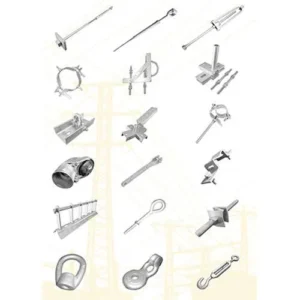

The Engineer’s Guide to Pole Line Fitting: Ensuring Mechanical Integrity
The stability and longevity of any power distribution network hinge on the quality of its Pole Line Fittings.
These are the critical, high-stress components that physically connect conductors, insulators, and secondary equipment
to the utility pole structure. While often small, their failure can cascade into catastrophic line collapses, making their
selection and specification one of the most vital tasks in power system construction and maintenance.
This technical guide dives deep into the primary categories of Pole Line Fitting—from conductor attachment hardware
to structural bracing—highlighting material requirements, load considerations, and compliance standards.
Categorizing Essential Pole Line Fittings
Pole Line Fitting components are typically grouped by their primary function: attachment (to the conductor), bracing (to the pole), or connection (linking different components).
1. Conductor Attachment Fittings: The Critical Interface
These fittings bear the tensile and gravitational forces exerted by the conductor. Their design must minimize stress
points on the conductor while maximizing holding strength.
Suspension Clamps
These pole line fittings cradle the conductor at intermediate support points. They hold the vertical load but allow
the conductor to move slightly, reducing bending fatigue. Suspension clamps are rated by their slip strength, ensuring
that the conductor releases before the pole or insulator fails under extreme asymmetrical loads.
Tension / Dead-End Clamps
Used at the beginning, end, and large corner angles of a line. They must hold the full mechanical tension of the conductor.
This category includes high-compression dead-end fittings (for permanent, full-strength connection) and mechanical wedge clamps.
Insulation Piercing Connectors (IPC)
Though primarily electrical connectors, IPCs serve as pole line fittings for tapping into Aerial Bundled Cables (ABC) without
stripping insulation, maintaining system integrity and weatherproofing.
2. Pole and Structure Fittings: Bracing and Support
These structural fittings secure cross-arms, braces, and load-bearing hardware directly to the pole. Their durability is
paramount to long-term system stability.
Pole Clamps and Straps
Used primarily for wooden poles or non-drilled concrete poles, these fittings wrap around the pole to secure components
like voltage regulators or cutouts without penetrating the pole material.
Cross-Arm Braces
Essential pole line fittings that reinforce the mechanical strength of the cross-arm assembly against transverse (sideways)
loads, such as high wind or unequal conductor tension.
Clevises and Shackles
These linkage fittings connect the insulator string to the cross-arm or the conductor clamp, acting as versatile pivot points
within the assembly.
Internal Link: View our selection of certified, high-tensile Pole Line Fittings and
Structural Pole Hardware, guaranteed for extreme weather performance.
Material Integrity and Corrosion Resistance
The longevity of a pole line fitting is fundamentally determined by its material composition and corrosion protection.
Since most structural components are made from carbon steel, protecting them from rust is non-negotiable.
The Standard: Hot-Dip Galvanization (HDG)
Every steel pole line fitting must be protected by Hot-Dip Galvanization (HDG). This process coats the steel with a
thick layer of zinc, which acts as a sacrificial anode—corroding slowly to protect the underlying metal. Compliance
with IS 2629 or ASTM A123 for HDG thickness is essential, especially in coastal or industrial zones.
Aluminum and Stainless Steel Usage
Fittings in direct contact with aluminum conductors (ACSR, AAAC) are typically cast from aluminum alloys to prevent
galvanic corrosion. Stainless steel is used for specialty fasteners and banding materials where extreme corrosion resistance
is required.
Critical Specifications for Pole Line Fitting Selection
1. Specified Mechanical Load (SML) and UTS
SML: Specifies the maximum mechanical load an insulator can sustain before failure.
UTS (Ultimate Tensile Strength): Defines the maximum breaking strength of metallic fittings such as dead-ends.
Reliable manufacturers ensure their fittings’ UTS matches or exceeds that of the conductor.
2. Conductor Compatibility
A fitting must precisely match the size and type of conductor (e.g., ACSR 100 sq. mm). Improper fit leads to abrasion, looseness,
and premature vibration-induced fatigue. Precision manufacturing tolerances are essential to prevent such failures.
Internal Link: Explore our specialized
Compression and Tension Fittings
designed for perfect conductor compatibility across all standard conductor sizes.
Quality Assurance and Compliance Standards
Procuring pole line fittings demands certification to internationally recognized standards, ensuring reliable performance
throughout the hardware’s service life.
Key Standards
- IEC 61284: General requirements and tests for line fitting clamps and mechanical fittings for bare conductors.
- BIS / ANSI: National standards defining material, galvanization, and dimensional criteria for utility pole hardware.
Critical Testing Methods
- Creep Test: Evaluates long-term deformation of compression fittings under sustained loads.
- Corona/RIV Test: Measures radio-interference voltage for high-voltage fittings.
- Fatigue Test: Simulates thousands of mechanical load cycles over a typical 30+ year lifespan.
By following these standards, utilities ensure every pole line fitting is structurally sound and electrically secure.
Frequently Asked Questions (FAQ)
What defines a Pole Line Fitting in power distribution?
A Pole Line Fitting is any component used to physically attach conductors, insulators, cross-arms, or bracing hardware
to a utility pole or tower, ensuring mechanical integrity and system reliability.
Why is the material selection crucial for Pole Line Fittings?
Material selection prevents galvanic corrosion. Aluminum alloy fittings are used for aluminum conductors,
while structural steel components require HDG coating to protect against rust and maintain strength.
What is the role of the Suspension Clamp?
The Suspension Clamp supports the vertical weight of the conductor at intermediate points and allows controlled movement
to minimize conductor stress and fatigue.
What does the term “Dead-End” mean in Pole Line Fittings?
The term refers to a point where a conductor terminates or anchors. Dead-end fittings hold the full longitudinal tension
of the conductor to prevent slipping or failure.