

The Definitive Guide to Insulator Hardware & Fittings for India’s EHV Grid
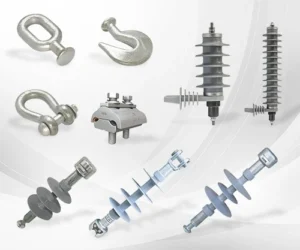
The longevity and stability of High Voltage (HV) and Extra High Voltage (EHV) transmission lines in India—spanning from coastal salinity zones to high-altitude areas—are fundamentally dependent on the performance of Insulator Hardware and Fittings. These components serve as the critical mechanical coupling and electrical protection for the insulator string, linking it securely to the tower and the conductor assembly.
As a market leader specializing in components for the Indian power sector, our entire product range is engineered to meet the stringent mechanical and electrical design parameters established by Indian Standards (IS) and major utilities like POWERGRID Corporation of India Ltd.
Core Insulator Hardware: Mechanical Coupling Systems
Insulator hardware must be capable of transferring massive tensile and compressive loads from the conductor to the tower, ensuring structural integrity under diverse climatic conditions such as high wind or ice loading.
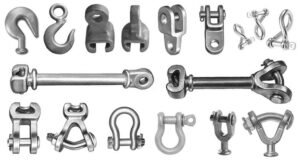
Ball-and-Socket and Clevis Fittings
These coupling systems are standardized to allow replacement and interchangeability across Porcelain, Glass, and Composite insulators.
- Ball-Eye and Socket-Eye (IEC Standard): Used in suspension strings, allowing 360° angular movement essential for conductor swing. Manufactured to comply with IEC 60383 for full interchangeability.
- Y-Clevises and Tongue & Clevis: Used in dead-end/tension assemblies, offering maximum mechanical strength to anchor full conductor load.
All coupling components must pass stringent mechanical tests, including routine proof load testing, as mandated by POWERGRID Technical Specifications.
Electrical Protection Accessories: EHV Field Management
Corona Rings and Arcing Horns
These components are essential for controlling electrical discharge phenomena at EHV voltages.
- Corona / Grading Rings: Required for 220 kV and above. They redistribute electric fields to suppress corona discharge and extend insulator life.
- Arcing Horns: Divert flashover arcs away from the insulator surface during lightning or switching surges, protecting the insulator body.
Hardware Material and Corrosion Resistance in India
India’s harsh coastal and industrial environments require best-in-class corrosion protection.
- Hot-Dip Galvanization (HDG): Compliant with IS:4759 and ASTM A123 ensuring 30+ years of corrosion resistance.
- Material Certification: High-strength forged steel and malleable iron are used, certified per relevant IS codes.
Compliance and Interoperability with Indian Utilities
Integration with Line Fittings and Pole Hardware
Insulator hardware serves as the interface between the insulator and transmission line fittings such as Dead-End Clamps and Suspension Clamps. It also ensures mechanical compatibility with tower attachment hardware.
Quality Assurance and Testing in India
We provide complete Type Test Certificates from NABL-accredited labs (CPRI, ERDA) for:
- Mechanical Failing Load (MFL) Test
- Visual & Dimensional Checks — IEC 60383 compliance
- Galvanization Thickness & Uniformity Tests
Our expertise includes assisting with tender documentation, vendor registrations, and technical clarifications for POWERGRID and State Transmission Utilities.
Frequently Asked Questions (FAQs) for Insulator Hardware in India
Q1: What standard governs the dimensions of Ball-and-Socket fittings in India?
A: IEC 60383, which defines ball sizes (e.g., 16 mm, 20 mm) and interchangeability dimensions.
Q2: Why must insulator hardware meet IS:4759?
A: It ensures minimum zinc coating thickness for long-term corrosion resistance.
Q3: What is the main benefit of using Grading Rings on 400 kV lines?
A: They equalize the electric field, preventing corona discharge and material erosion.
Q4: How do you ensure compatibility with POWERGRID’s 765 kV requirements?
A: By meeting very high MFL ratings and performing mandatory RIV (Radio Interference Voltage) testing.
Q5: Which fitting type is stronger: Ball-Eye or Y-Clevis?
A: Y-Clevis assemblies generally offer higher Ultimate Tensile Strength for dead-end applications.
Q6: What is the material of the pin in a Ball-Eye fitting?
A: Stainless steel or galvanized steel, often with a cotter key locking system.
Q7: What is ‘Tracking’ on insulator surfaces?
A: Carbonized paths caused by leakage currents. Proper grading rings reduce electric field stress and tracking.
Q8: Where does NABL certification apply?
A: In third-party testing for mechanical, RIV, and galvanization tests at labs like CPRI and ERDA.
Q9: How is Ball Size (e.g., 24 mm) determined?
A: Based on required mechanical failing load — higher loads require larger ball diameters.
Q10: What is the role of a Yoke Plate?
A: To connect multiple insulator strings or distribute load evenly for bundled conductors.
{
“@context”: “https://schema.org”,
“@graph”: [
{
“@type”: “Product”,
“name”: “Insulator Hardware & Fittings for Indian Transmission Lines”,
“description”: “Certified Ball-Eye, Socket-Eye, Arcing Horns, and Grading Rings compliant with IS, IEC 60383, and POWERGRID specifications for HV/EHV systems in India.”,
“sku”: “IHW-IND-2025-EHV”,
“brand”: {
“@type”: “Brand”,
“name”: “Damiano”
},
“aggregateRating”: {
“@type”: “AggregateRating”,
“ratingValue”: “4.8”,
“reviewCount”: “98”
},
“offers”: {
“@type”: “Offer”,
“priceCurrency”: “INR”,
“price”: “Request Quote”,
“availability”: “https://schema.org/InStock”
}
},
{
“@type”: “FAQPage”,
“mainEntity”: [
{
“@type”: “Question”,
“name”: “What standard governs the dimensions of Ball-and-Socket fittings in India?”,
“acceptedAnswer”: {
“@type”: “Answer”,
“text”: “The primary standard is IEC 60383, which dictates the interchangeability dimensions (like ball size, e.g., 16mm, 20mm) to ensure hardware from different suppliers can be safely assembled.”
}
},
{
“@type”: “Question”,
“name”: “Why must insulator hardware meet IS:4759?”,
“acceptedAnswer”: {
“@type”: “Answer”,
“text”: “IS:4759 is the Indian Standard for the specification of zinc coating on steel components. Meeting this is vital to guarantee the specified long-term corrosion resistance required for utility service in India.”
}
},
{
“@type”: “Question”,
“name”: “What is the main benefit of using Grading Rings on 400kV lines?”,
“acceptedAnswer”: {
“@type”: “Answer”,
“text”: “Grading Rings (Corona Rings) equalize the electric field at the conductor and tower ends of the insulator string, preventing the high-voltage stress that causes corona discharge, radio interference, and material erosion.”
}
},
{
“@type”: “Question”,
“name”: “How do you ensure your insulator hardware is compatible with POWERGRID’s 765kV requirements?”,
“acceptedAnswer”: {
“@type”: “Answer”,
“text”: “For 765kV, hardware must meet extremely high MFL ratings and be subjected to strict RIV (Radio Interference Voltage) testing, as specified in the latest POWERGRID technical schedules.”
}
},
{
“@type”: “Question”,
“name”: “Which fitting type is stronger: Ball-Eye or Y-Clevis?”,
“acceptedAnswer”: {
“@type”: “Answer”,
“text”: “Typically, the Y-Clevis assembly is engineered for higher Ultimate Tensile Strength (UTS) as it is designed for dead-end applications where it must anchor the entire conductor load.”
}
},
{
“@type”: “Question”,
“name”: “What is the material of the pin in a Ball-Eye fitting?”,
“acceptedAnswer”: {
“@type”: “Answer”,
“text”: “The locking pin is usually made of stainless steel or galvanized steel, often designed with a quick-release mechanism (like a cotter key) for ease of maintenance while ensuring secure locking under load.”
}
},
{
“@type”: “Question”,
“name”: “What is ‘Tracking’ in relation to insulator hardware protection?”,
“acceptedAnswer”: {
“@type”: “Answer”,
“text”: “Tracking is the formation of a carbonized path on the insulator surface due to continuous leakage current. Grading rings and optimized hardware geometry help minimize the electric field, thereby reducing the likelihood of tracking damage.”
}
},
{
“@type”: “Question”,
“name”: “Where does the NABL certification apply in hardware testing?”,
“acceptedAnswer”: {
“@type”: “Answer”,
“text”: “NABL (National Accreditation Board for Testing and Calibration Laboratories) accredited labs in India perform the required third-party type tests (MFL, RIV, Galvanization thickness) to provide official compliance certificates.”
}
},
{
“@type”: “Question”,
“name”: “How is Ball Size (e.g., 24mm) determined?”,
“acceptedAnswer”: {
“@type”: “Answer”,
“text”: “The ball size is determined by the required mechanical failing load of the insulator string; higher loads necessitate larger, stronger ball dimensions for load distribution.”
}
},
{
“@type”: “Question”,
“name”: “What is the role of a Yoke Plate in insulator assemblies?”,
“acceptedAnswer”: {
“@type”: “Answer”,
“text”: “A Yoke Plate is used to connect multiple insulator strings to a single conductor termination (especially for bundled conductors) or to the tower, ensuring the load is distributed evenly across all parallel strings.”
}
}
]
},
{
“@type”: “WebPage”,
“name”: “Insulator Hardware & Fittings in India: Certified Ball-Eye, Socket-Eye, and Grading Rings (IS/POWERGRID Compliant)”,
“url”: “https://adamiano.com/insulator-hardware-fittings-india/”,
“datePublished”: “2025-12-04”,
“dateModified”: “2025-12-04”,
“mainEntityOfPage”: {
“@type”: “WebPage”,
“@id”: “https://adamiano.com/insulator-hardware-fittings-india/”
}
}
]
}